.png)
.svg)



It has been a season of the blockbuster IPO. With the record- breaking debut of SpaceX and growing attention to potential offerings from Anthropic and OpenAI, it is an opportune time to take a closer look at the initial public offering (IPO).
What Is an IPO?
An initial public offering, or IPO, is the process a company uses to sell its first shares to the public before the stock trades on an exchange. The offering price is determined by the company and its underwriters, based on factors such as comparable company valuations, investor demand and prevailing market conditions.
The lead underwriter allocates the vast majority of IPO shares to institutional investors, such as pension funds and mutual funds, with only a small percentage allocated to retail investors. When new shares are issued, the proceeds from their sale go to the company, with the underwriters receiving a portion as fees. Once the IPO is complete, the company’s shares simply trade between investors on the secondary market, typically through a stock exchange.
Why Companies Go Public
In the past, companies needed to go public earlier to access larger pools of capital to help fund capital expenditures, investments or other expansion. Today, with the growth of private markets, many companies can raise capital without going public through venture capital or private equity. This allows companies to stay private for longer and potentially grow much larger before an IPO, helping to explain the mammoth debuts we are seeing today. When they do eventually go public, they may do so to provide liquidity for private investors or existing shareholders, broaden access to capital or establish a public market valuation and greater market visibility.
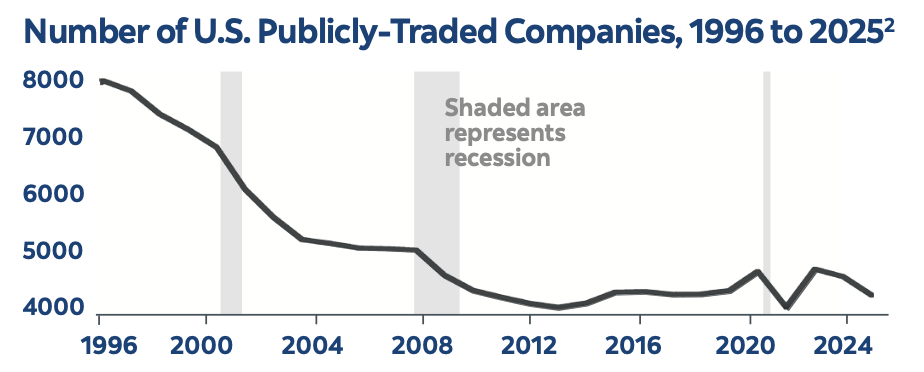
The shift has been significant: the number of U.S. publicly listed companies has fallen by more than half since its 1996 peak, from more than 8,000 to fewer than 4,000 today. IPO activity tells a similar story. While around 400 companies went public annually during the 1990s, there have been fewer than 200 traditional IPOs per year on average more recently. Yet 2026 is shaping up to be a record year for IPO activity in dollar terms.
What Should Investors Know?
Going public brings greater transparency. Public companies are subject to ongoing disclosure requirements, including regular financial reporting, giving investors greater insight into their operations and performance.
There is often significant hype surrounding high-profile IPOs. In the days and even weeks surrounding a public debut, it is not uncommon for share prices to fluctuate significantly as investors reassess the company’s valuation once its shares begin trading publicly.
IPOs can also attract significant investor enthusiasm, particularly when a company has a compelling growth story. However, those expectations may already be reflected in the offering price. A compelling company does not necessarily make a compelling investment at any price. As with any investment, this is where disciplined analysis matters — assessing the company’s fundamentals, valuation and prospects within the context of an investor’s broader portfolio and objectives.
1. https://site.warrington.ufl.edu/ritter/ipo-data/ ; 2. https://data.worldbank.org/indicator/CM.MKT.LDOM.NO?locations=US



.svg)
.svg)
.png)

.png)

