.png)
.svg)


A recent op-ed in the popular press recalled a time when boredom was simply part of daily life. There was no “on demand”: entertainment meant rewinding cassette and VCR tapes, playing board games or just staring out the car window. Growing up in the 1980s and 1990s, before the internet or social media, nothing competed for our attention.
Today, ultra-short attention spans have reshaped behaviour, creating an almost reflexive need to escape boredom. This shift has had meaningful implications for investing. While discount brokerages have democratized investing access, they have also democratized short-term behaviour. It’s something we’ve pointed to before: average stock holding periods have collapsed from years to mere months; the median self-directed investor reportedly spends just six minutes researching a stock before buying it; and a recent CBC article described young investors as “investing on vibes.”
As advisors, these trends are concerning. But they raise an important question: Are shorter market cycles becoming the norm, or has a decade of rapid recoveries conditioned investors to expect them?
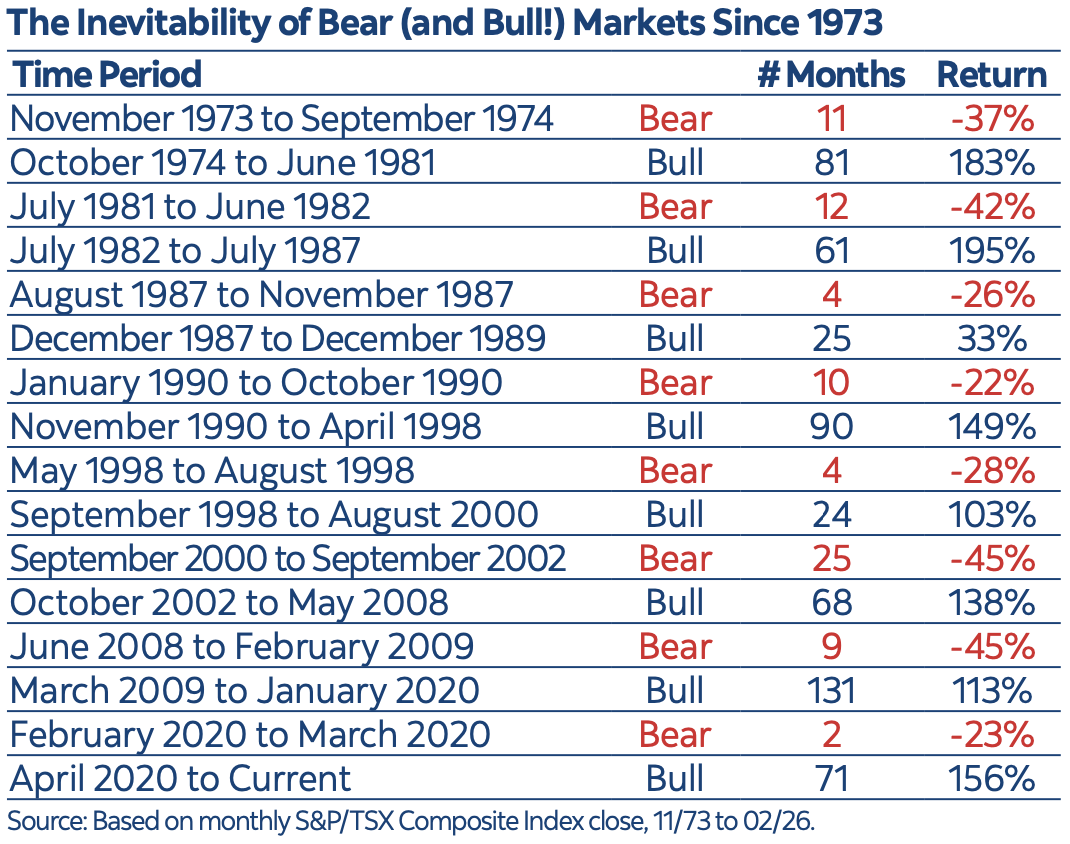
For more than a decade, “buy the dip” has been rewarded, while policymakers have repeatedly cushioned economic slowdowns with monetary and fiscal stimulus, dulling the markets’ sensitivity to underlying weakness. As a result, we haven’t experienced a significant recession for a long time, nor have we endured an extended bear market. Yet history reminds us that prolonged bear markets can emerge when deeper structural weaknesses ultimately surface. Over the past 53 years, we’ve seen eight bear markets lasting a cumulative 77 months (chart). Underlying structural vulnerabilities, such as growing national debt and weakening balance sheets, can eventually assert themselves over time.
The Global Financial Crisis of 2008-09 is one such reminder. In the U.S., the economy required years, not months, to heal, and markets reflected this reality as confidence took time to rebuild. The S&P 500 fell roughly 57 percent from peak to trough and took nearly 66 months, or five and a half years, to reclaim its previous high. Canadian markets fared somewhat better but, based on monthly figures, the S&P/TSX Composite Index still declined by 45 percent. Many investors, particularly young ones, exited the markets; some permanently.
This is not intended to provoke near-term worry. Corporate earnings remain solid, and household balance sheets are among the strongest in recent times. However, several enduring lessons are worth repeating. Severe dislocations can take time to heal. Financial institutions and capital markets did not stabilize overnight, but they ultimately recovered. Corporate earnings responded similarly. While fiscal and monetary intervention prevented a depression-like outcome, the recovery still required patience, and valuations only became attractive with time. Yet memories also fade, demographics shift, and new marginal buyers eventually emerge.
So, what happens if we face a prolonged bear market? The short attention spans cultivated by the internet and social media suggest that patience during an extended recovery may be far more challenging. At the same time, the growing influence of younger retail investors could signal a new era, potentially shortening future bear markets compared with historical norms.



.svg)
.svg)
.png)

.png)

