.png)
.svg)


The Dow Jones Industrial Average (DJIA, or “Dow”) crossed the 50,000 threshold at the start of the year. Since November, it has outperformed the S&P 500 and NASDAQ, prompting one headline to read: “The Dow, the Uncool Index, Has Its Moment in the Sun.”
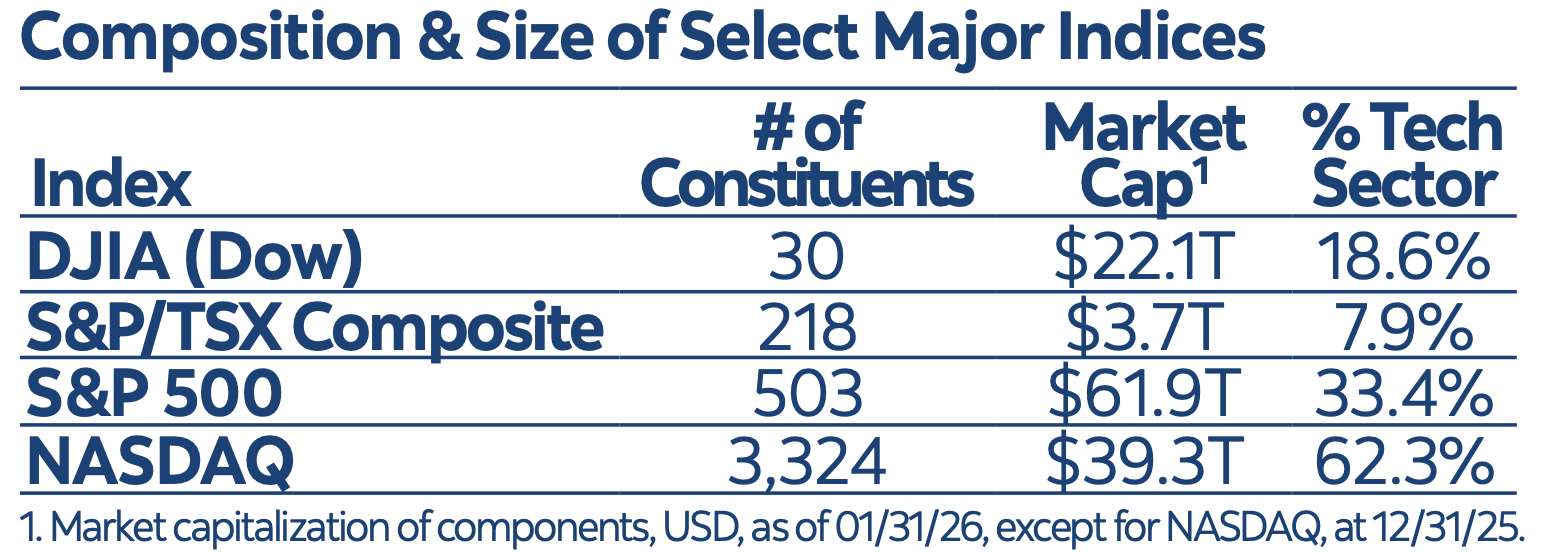
Celebrating its 130th birthday this spring, the Dow was launched in 1896 by Charles Dow, then-editor of The Wall Street Journal. It originally tracked 12 heavy-industry companies, hence the name “Industrial Average.” Today, it comprises 30 companies, updated periodically to reflect leaders of the modern economy.
What distinguishes the Dow is its “price-weighted” methodology. The index is calculated by adding component share prices and dividing them by a divisor that accounts for stock splits or other structural changes. By contrast, indices such as the S&P/ TSX Composite, S&P 500 and NASDAQ are weighted based on share of total market capitalization (share price multiplied by outstanding shares).
Is the Dow a good gauge of the U.S. economy? Throughout its history, it has faced criticism. Some argue that 30 companies provide too narrow a representation of the market. Others suggest its price-weighted methodology is flawed because higher-priced stocks tend to have greater influence over lower-priced counterparts.
What is particularly notable today is that the Dow’s rise may signal stronger market breadth beyond technology, which makes up 62 percent of the NASDAQ, 33 percent of the S&P 500, but only 19 percent of the Dow. Taking a broader perspective, while all indices have limitations, they remain useful barometers. The Dow’s long history and continued growth highlight the enduring trajectory of economic progress.



.svg)
.svg)
.png)

.png)

