.png)
.svg)



Transferring wealth efficiently across generations is a key challenge faced by many high-net-worth (HNW) families. While traditional strategies often focus on trusts or gifting, an often-overlooked approach is using permanent life insurance as a long-term estate planning tool, particularly when the policy insures a child.
Why start early? Establishing a policy early in life provides distinct advantages: Premiums are generally much lower, locking in lifetime coverage at a lower cost than an adult policy, while coverage can be secured before any potential health issues arise. The policy may also have more time to accumulate tax-deferred cash value.
The concept is straightforward: A parent or grandparent purchases a permanent life insurance policy on a child in good health, acting as the policy owner. Over time, policy ownership can be transferred on a tax-deferred basis to the child, provided it is carefully structured and certain conditions are met.
Here are the key benefits, in greater detail:
• Lower Premiums — Because children and young adults have longer life expectancies, premiums are generally much lower. This can provide lifetime coverage at a lower cost than purchasing insurance later in life.
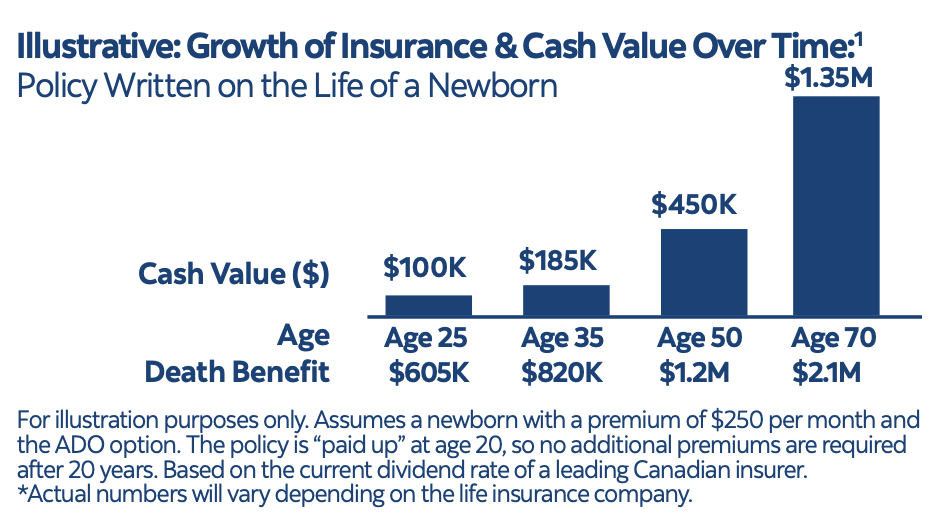
• Growth Potential of Cash Value — With a longer time horizon, the policy’s tax-deferred cash value has greater potential to grow, supporting long-term wealth accumulation. The chart shows how cash value can accumulate under a participating whole life insurance policy starting in the first year of a child’s life. In the example, with a 20-pay whole life policy, the $250 monthly premium ends after 20 years, yet coverage remains in place for the insured’s life and the cash value continues to grow.¹
• Liquidity Options — The policy owner can access the cash value during their lifetime, subject to tax implications. Once ownership is transferred and the child becomes the policy owner, they may access the cash value to help fund education, business opportunities or other financial needs.
• Tax-Efficient Transfer — Upon the death of the policy owner, ownership may transfer to the child (the life insured) on a generally tax-deferred basis, preserving value for the next generation.²
• Tax-Free Death Benefit — The child’s beneficiaries may potentially receive the death benefit tax-free and outside the probate process, helping avoid probate fees (where applicable), delays or potential creditor claims. The death benefit can grow over time (chart).
Considerations and Risks
This is a long-term strategy, with the greatest benefits typically realized in the future, upon the child’s passing. Families must be comfortable with reduced short-term liquidity due to ongoing premium costs* and a long time horizon for realizing the strategy’s full value. Ownership changes must be carefully structured to avoid triggering attribution rules or unintended tax consequences.
The Bottom Line
Life insurance can be a powerful, tax-efficient wealth transfer tool for HNW families. Starting early provides additional flexibility, long-term growth potential and the opportunity to build a lasting legacy. Like any insurance strategy, it is most effective when integrated into a broader estate and succession plan, implemented with guidance from tax, legal and insurance specialists. For an insurance illustration tailored to your particular situation, please call.
1. https://www.policyadvisor.com/life-insurance/life-insurance-for-children/; 2. Where subsection 148(8) of the Income Tax Act (Canada) allows for a tax-deferred rollover to a child.
*As with all insurance products, premiums must be maintained to keep the policy in force.



.svg)
.svg)
.png)

.png)

