.png)
.svg)



Many of us spend years contributing to our Registered Retirement Savings Plan (RRSP) to take advantage of the tax-deferred growth opportunity. Yet we may forget to plan our exit strategy: how and when that money will be withdrawn in the future.
The issue? Every dollar withdrawn from the RRSP is subject to tax as regular income. While postponing withdrawals until retirement is often beneficial, because in many cases the individual will be in a lower marginal tax bracket, waiting too long can create other issues. By age 71, the RRSP would likely be converted to a Registered Retirement Income Fund (RRIF), forcing the planholder to withdraw specified percentages of the RRIF, whether funds are needed or not. In addition, leaving significant RRSP/RRIF funds to beneficiaries at death can result in a substantial tax liability. If there is no qualified rollover beneficiary, the full value is included in the deceased’s final tax return, which, for many high-net-worth (HNW) investors, can be taxed at the highest marginal rate.
Couples: Joint Last-to-Die Insurance as a Solution
If RRSP/RRIF funds aren’t needed as income in retirement, using joint last-to-die insurance may be a solution. It allows you to reposition assets during your lifetime, while preserving estate value through tax-free insurance proceeds. Withdrawals from a RRSP/RRIF are used over time to fund the policy, which may be subject to relatively lower marginal tax rates compared to taxes at death. The life insurance policy helps preserve the after-tax estate value for beneficiaries by replacing assets withdrawn and taxed during retirement.
How Does It Work?
Consider the situation in which a couple is planning to leave their estate to their children. Each spouse can designate the other as the beneficiary of their own RRSPs and purchase joint last-to-die life insurance with the children as beneficiaries of the insurance policy.
At retirement, withdrawals from the RRSP or, later, the minimum RRIF withdrawals, can be used to pay the insurance premiums. By making use of the spousal rollover provision available, there will generally be no RRSP/RRIF-related taxes due on the death of the first spouse, as the RRSP/RRIF will transfer to the other spouse without tax implications. Upon the death of the surviving spouse, insurance proceeds will be generally paid out tax-free to the beneficiary(ies).
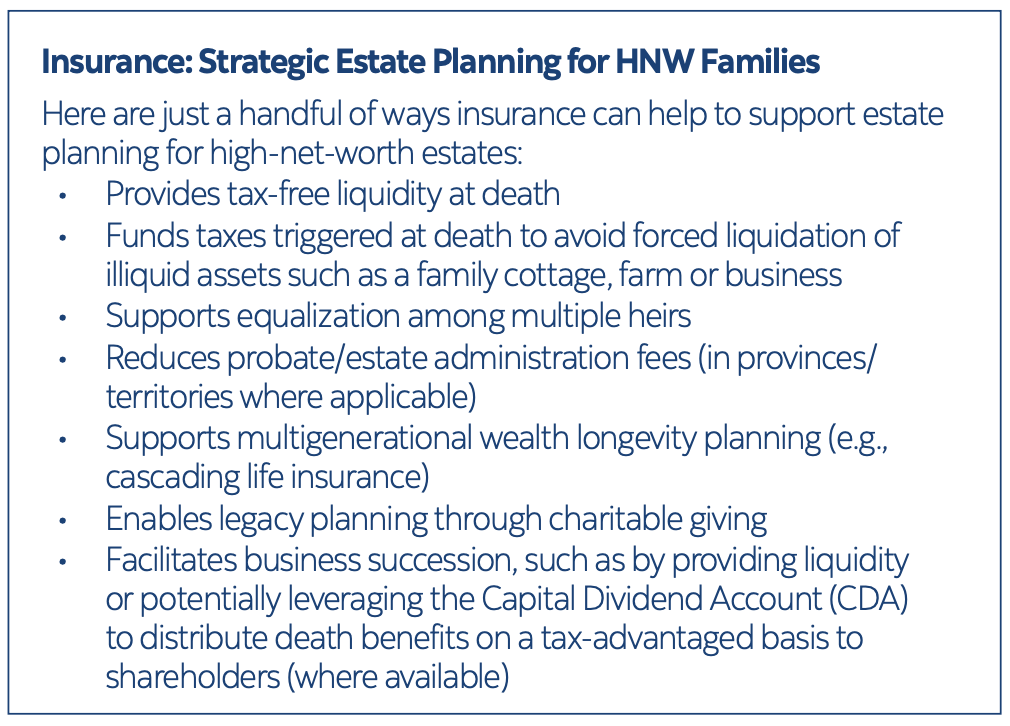
This strategy may help manage or reduce overall lifetime and estate tax exposure in certain situations. In many cases, joint last-to-die life insurance can help preserve or enhance the value of an estate. In provinces where estate administration tax (probate) is assessed, there may be additional savings as insurance proceeds bypass the estate.
The proceeds paid out from the life insurance policy can be designated to offset future tax liabilities. For example, the insurance policy proceeds can cover taxes arising from the deemed disposition of capital assets, without requiring the liquidation of the estate assets to fund the tax liability. Alternatively, proceeds can be used to create a legacy by naming a charity as the designated beneficiary.
The joint last-to-die policy is often more cost-effective than the purchase of two individual single life policies since the insurance company does not plan to pay out proceeds until further into the future, and it only needs to pay this out on one policy rather than two.
Determining if life insurance can play a role in your estate plan depends on your circumstances and future goals. Given our familiarity with your investments, we would be pleased to provide perspectives.


.svg)
.svg)
.png)

.png)
.png)
