.png)
.svg)



It may be one of the more memorable pieces of advice for new graduates heading out into the real world. “If you want to change the world, start by making your bed.”
These words, delivered by Admiral William McRaven to a commencement crowd in 2014, were drawn from his Navy SEAL training, one of the most gruelling and disciplined programs in the world.* Yet, his message was deceptively simple.
It’s a lesson that translates across all walks of life. If you can master small habits, like consistently making your bed each day, you build the discipline needed to handle the bigger challenges.
This summer, around 600,000 students are expected to graduate from Canadian colleges and universities, alongside another 350,000 high school graduates. Chances are, you know one of them. For those just starting out, this message may be worth passing along.
Investing follows a similar path. Getting the small things consistently right can significantly improve long-term outcomes. Building wealth is rarely about one-time decisions — and almost never about achieving success quickly.
Instead, it comes down to habits: saving regularly, avoiding unnecessary debt, consistently investing and maintaining discipline when markets feel uncertain.
Here are two examples to share with new graduates that show the power of these choices:
The Impact of Time
Compare two investors who each contribute $10,000 annually for 20 years at a 5.5 percent compounded annual return.
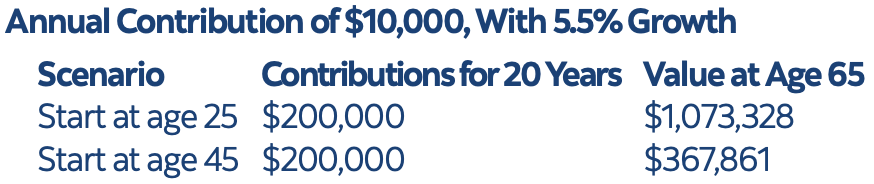
The math is compelling. Both investors contribute the same $200,000. Yet the one who starts at age 25 ends up with roughly $1.07 million by age 65, assuming the capital is left untouched to compound. By contrast, by waiting until age 45, the portfolio grows to only $367,861. The difference is driven by time in the market, not the amount invested. Even a 5.5 percent return is modest and attainable, underscoring how powerful time can be.
The Impact of Consistent Contributions
If $10,000 per year seems difficult early in a career, smaller contributions can still lead to meaningful results. Consider how $417 per month (or $5,000 annually) can grow within an RRSP starting at age 25, assuming a 5.5 percent return:
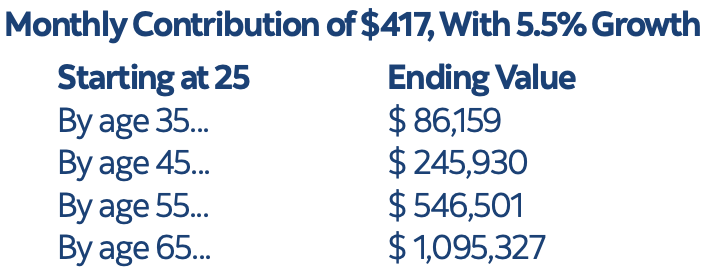
What begins as a relatively modest balance in the younger years can compound to over $1 million by age 65. This assumes an entry-level income (an annual salary of at least $28,000), supported by the tax deduction on RRSP contributions that can help stretch a paycheque in the early career years.
Indeed, financial decisions made early may seem insignificant, but they can have a profound impact over time.
Congratulations, graduates — and welcome to the real world! Small things, done consistently, have a way of compounding in both life and investing. Sometimes it really can start with something as simple as making your bed.
*It would later inspire the #1 New York Times bestseller Make Your Bed, a book offering simple wisdom, practical advice and steady encouragement.


.svg)
.svg)
.png)

.png)
.png)
